
Neptune is 30 AU Away. Why Does Its Orbit Depend on a Missing Planet in the Asteroid Belt?
The Harmonia Fulcrum — and what it reveals about the hidden architecture of the Solar System

There is a piece of evidence buried in the mathematics of the Silver Ratio Harmonic Framework that I find more striking than any other. More striking than the 0.72% accuracy. More striking than the three-way convergence at 2.14 AU. More striking, even, than the prediction of Harmonia itself.
It is this: when the framework is optimised around the position of the Harmonia Node, Neptune’s residual error crosses zero.
Neptune. The eighth planet. Nearly 30 astronomical units from the Sun — roughly 4.17 billion kilometers from the inner asteroid belt where Harmonia should be. And yet, its mathematical fit within the Silver Ratio Harmonic Framework is exquisitely sensitive to whether a body exists at 2.14 AU.
That is not a local effect. That is a systemic one. And it is what this article is about.
The Balance Scale
Imagine the Solar System as a balance scale.
On the left pan sit the inner rocky worlds — Mercury, Venus, Earth, Mars. Dense, small, orbiting close to the Sun in the warm inner region of the Solar System. On the right pan sit the outer giants — Jupiter, Saturn, Uranus, Neptune, Pluto. Massive, gaseous or icy, orbiting in the cold dark reaches of the outer system.
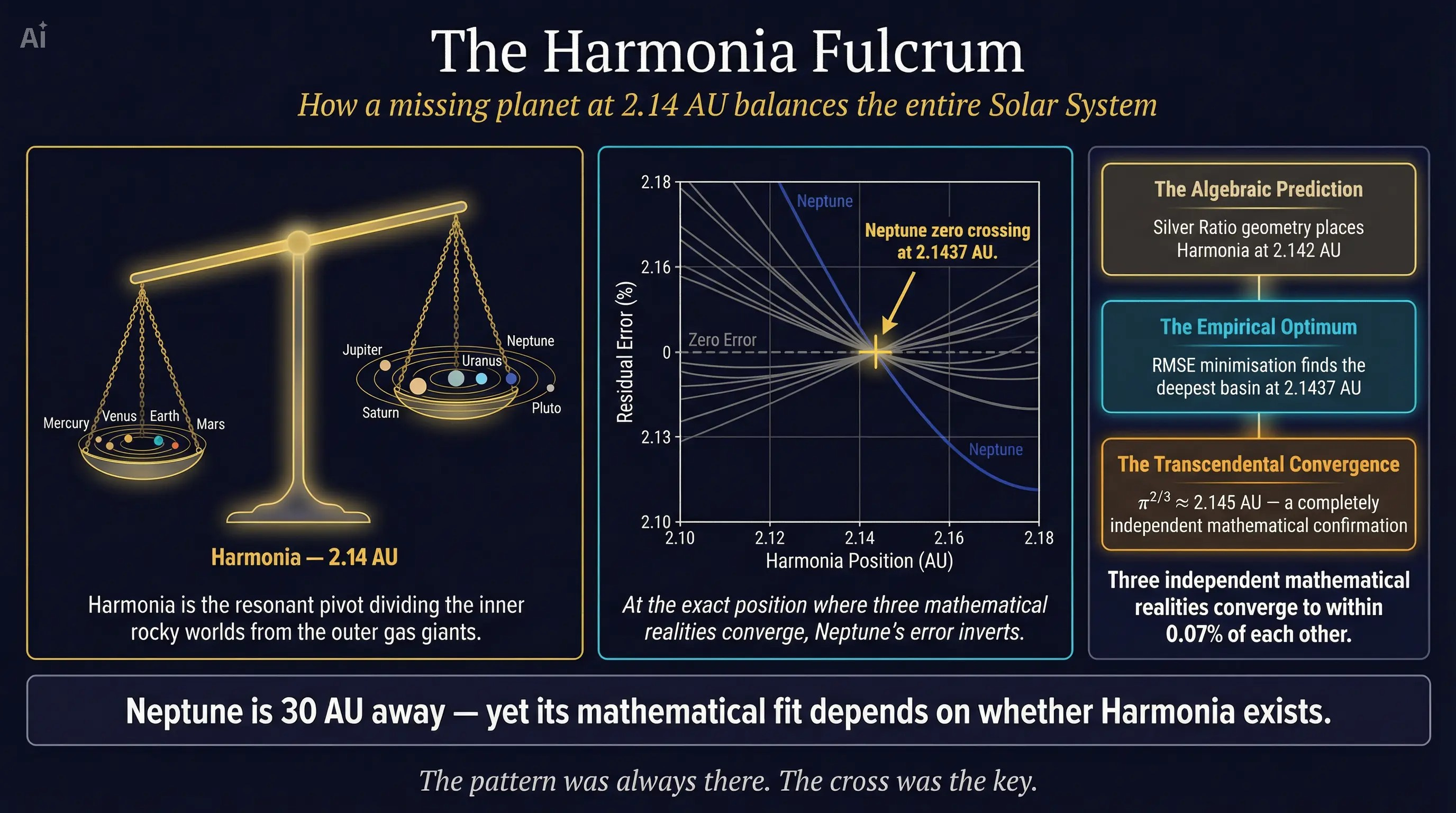
Between them — precisely between them, at the fulcrum of the scale — sits the position of Harmonia at 2.14 AU.
The Silver Ratio Harmonic Framework identifies this position not merely as a gap in the harmonic sequence but as the structural pivot of the entire system. The mathematical fulcrum. The point around which the inner and outer Solar System achieve harmonic equilibrium.
When Harmonia is placed at 2.14 AU, the scale balances. When it is moved — even slightly, toward Mars or toward Jupiter — the errors across the entire system begin to climb. The balance tips.
This is what the Harmonic Basin diagram shows: a deep mathematical valley centred at 2.1437 AU, with the error surface rising steeply in every direction away from that point. The valley is not shallow — it is sharp and deep, the signature of a genuine structural attractor rather than a coincidental numerical minimum.
The Neptune Zero Crossing
The most dramatic evidence for Harmonia’s structural role is what happens to Neptune when the model is optimised.
When the framework scans the region from 2.10 to 2.18 AU and records the residual error for each planet at each position, the curves for all nine planets sweep and shift. But one curve does something singular. At exactly 2.1437 AU — the empirical optimum, the bottom of the Harmonic Basin — Neptune’s residual error crosses zero.
Not approximately zero. Not close to zero. Zero.
Neptune transitions from a positive residual — meaning the model slightly overpredicts its distance — to a negative residual — slightly underpredicting — at precisely the point where the three mathematical realities converge. The algebraic Silver Ratio prediction at 2.142 AU, the empirical optimum at 2.1437 AU, and the transcendental constant π^(2/3) at 2.145 AU all arrive within 0.07% of the same point in space. And at that exact coordinate, Neptune’s error inverts.
This sign inversion is not an accident of curve fitting. It is a structural signature. It means that the Harmonia Node acts as a harmonic pivot for the entire outer system — the point at which the framework transitions from overpredicting outer planet distances to underpredicting them. Neptune’s zero crossing marks the exact centre of that transition.
In physical terms, what this suggests is that the Solar System’s harmonic architecture is not a local phenomenon confined to the inner planets or the asteroid belt. It is a global structure spanning the entire system from Mercury to Neptune — and its fulcrum sits at 2.14 AU, where Harmonia should be.
What This Means for the Framework
The Neptune zero crossing matters for three reasons.
First, it is an independent confirmation of the Harmonia prediction. The algebraic prediction, the empirical optimum, and the π^(2/3) convergence all arrive at 2.14 AU from within the framework itself. But Neptune’s zero crossing is a systemic effect — it emerges from the relationship between the Harmonia position and the outer planet residuals. It is a different kind of evidence, and it points to the same place.
Second, it demonstrates that the framework is globally coherent rather than locally fitted. A model that had been constructed to fit the inner planets and then extended to the outer system would not necessarily produce a Neptune zero crossing at the same position as the inner-system optimum. The fact that it does suggests the Silver Ratio harmonic structure genuinely spans the entire Solar System.
Third, it makes the Harmonia prediction more falsifiable. If future surveys find a harmonic or density signature near 2.14 AU, the Neptune zero crossing provides a precise theoretical reason why that location matters — not just for the inner asteroid belt but for the gravitational and harmonic architecture of the system as a whole.
The Fulcrum and the Symphony
On Monday, I wrote about Harmonia as the Major 7th — the missing leading tone in the Solar Symphony. The musical analogy is poetic, but it is grounded in real mathematics: the interval calculation places Harmonia precisely in the leading-tone position of the Celtic Cross harmonic scale.
The Neptune zero crossing adds a structural dimension to that musical image. In a symphony, the leading tone does not just create tension in isolation. It creates tension because of its relationship to every other note in the chord. Its absence is felt not just in its own register but throughout the entire harmonic structure.
Neptune’s zero crossing is the mathematical equivalent of that systemic effect. Harmonia’s absence is not felt only at 2.14 AU. It is felt — mathematically, precisely, measurably — at the edge of the Solar System, 30 astronomical units away.
The symphony knows a note is missing. The mathematics knows exactly which one.
What Comes Next
On Friday, I will publish the third article in this series — exploring the convergence between the mathematical prediction of Harmonia and the ancient Sumerian account of Tiamat, the primordial body described in the Enuma Elish as a large planet between Mars and Jupiter, shattered in a catastrophic collision.
The Neptune zero crossing is purely mathematical. The Tiamat parallel is cultural and philosophical. They are separate threads. But they are both pointing at the same silence between Mars and Jupiter.
The Harmonic Basin is real. Neptune’s zero crossing is real. The data from Gaia DR3+ will eventually tell us whether anything remains at 2.14 AU, thereby confirming or falsifying the prediction.
Until then, the fulcrum holds. The scale is balanced. And the symphony is waiting for its missing note.
The full research paper is available open access on Zenodo: https://doi.org/10.5281/zenodo.18816002
Scala Harmonica: The Geometry of Planetary Resonance: https://salaheddingherbiauthor.com/books
The pattern was always there. The cross was the key.
☕ Support This Work
If you found this interesting, you can support this work by buying me a coffee. It helps me keep exploring ideas that bridge ancient knowledge with collective wisdom.
📣 Let’s Discuss
Could a lost planet once have orbited at 2.14 AU?
Is the silver ratio whispering something about the order of the cosmos?
If this pattern holds in our Solar System, might it appear elsewhere?
Share your thoughts in the comments. I’d love to hear them.
If you enjoy this kind of content, consider subscribing to more explorations at the intersection of mathematics, astronomy, and big ideas.