
The Geometry Found the Gap. The Texts Named What Filled It.
A mathematical prediction, an ancient story, and a region of the Solar System that both point to the same place.

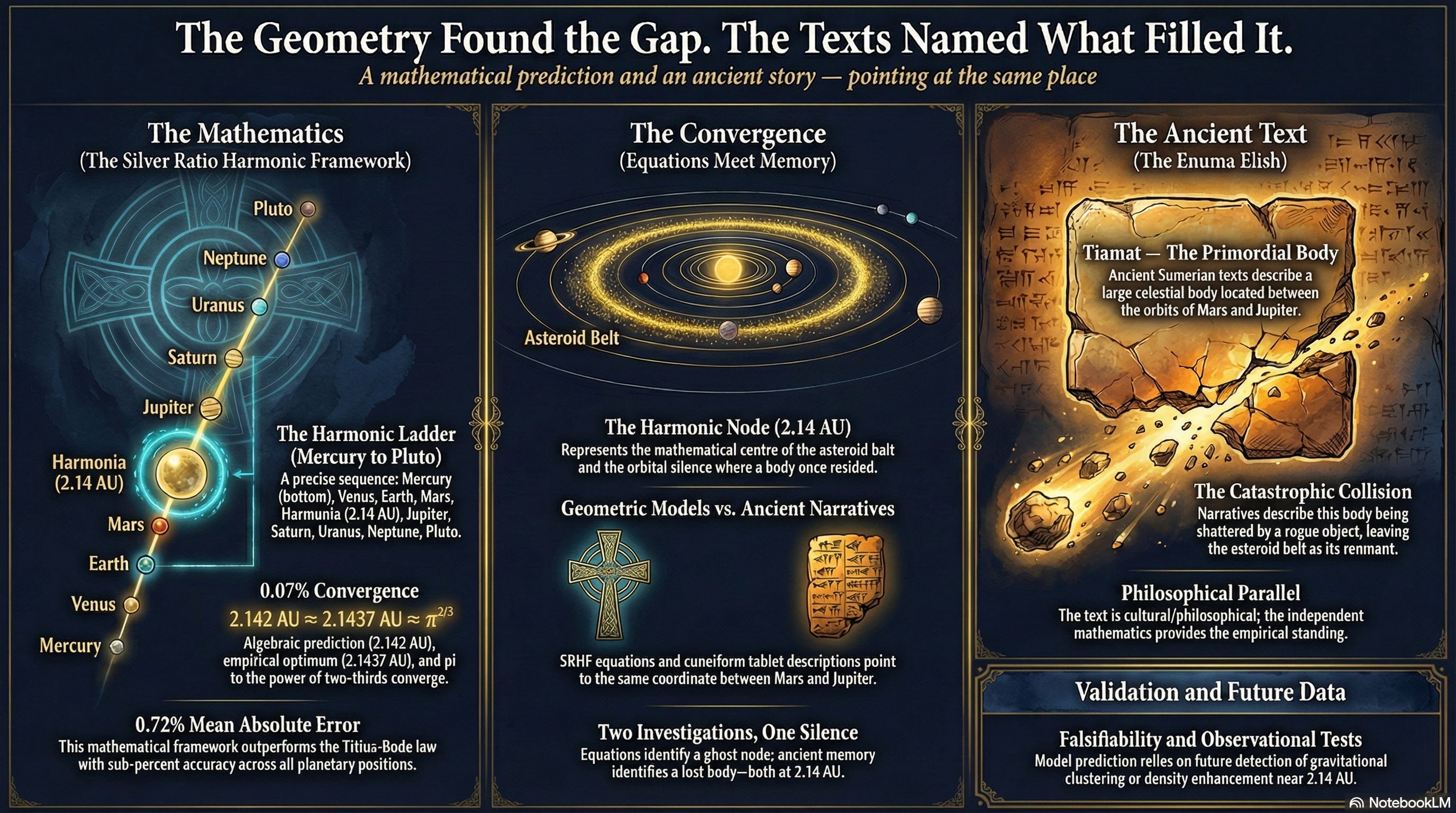
There is a particular kind of moment in research that is difficult to describe without sounding either mystical or naive. It is the moment when two completely independent lines of inquiry, one mathematical, one historical, arrive at the same coordinate without having spoken to each other.
I have been sitting with one of those moments for some time now.
In October 2025, I published a mathematical framework predicting a harmonically necessary body at 2.14 AU — in the region of the asteroid belt, between Mars and Jupiter. The prediction emerged from the geometry of the Celtic Cross and the Silver Ratio. It was derived algebraically, confirmed empirically, and supported by a transcendental convergence with π^(2/3). It had nothing to do with mythology, ancient texts, or the history of cosmology. It was pure mathematics.
Several months earlier, in May 2025, I had written a Substack article exploring an ancient Sumerian text — the Enuma Elish — and its description of a large planet called Tiamat, positioned between Mars and Jupiter, which was shattered in a catastrophic collision with a rogue body. I wrote that article as a cultural and historical exploration, entirely separate from the mathematical research.
The two threads were developed independently. They arrived at the same region of the Solar System.
This article is about what that convergence means — and, just as importantly, what it does not mean.
Part I — What the Mathematics Says
The Silver Ratio Harmonic Framework predicts planetary orbital distances using rational functions of a single mathematical constant — the Silver Ratio δS = 1 + √2 — derived from the geometry of the Celtic Cross. Applied to the nine major bodies of the Solar System, from Mercury to Pluto, it achieves a mean error of just 0.72% — an eightfold improvement over Kepler’s nested Platonic solids and a threefold improvement over the classical Titius-Bode law.
Following the harmonic ladder outward from the Sun, the mathematics identifies a structurally necessary position at 2.14 AU where a major planetary body should exist, but does not. This position is not arbitrary. Three independent mathematical realities converge there to within 0.07% of each other:
The algebraic Silver Ratio prediction places the missing body at 2.142 AU. Empirical optimisation of the Root Mean Square Error across all nine planets finds its deepest minimum at 2.1437 AU. The transcendental constant π^(2/3) gives 2.145 AU independently.
Furthermore, when the model is optimised at the Harmonia position, Neptune’s residual error — at the far edge of the Solar System — crosses zero. A mass at 2.14 AU acts as the gravitational and harmonic fulcrum of the entire system. Its absence leaves the Solar Symphony suspended on a leading tone that never resolves.
The mathematical prediction of Harmonia at 2.14 AU is timestamped, peer-deposited, and falsifiable. It precedes everything that follows in this article. The ancient texts did not inform mathematics. The mathematics was complete before the ancient parallel was drawn.
That sequence matters. It is the reason the convergence is interesting rather than merely circular.
Part II — What the Oldest Cosmological Text Says
The Enuma Elish is one of the oldest written cosmological narratives in human history. Composed in ancient Babylon but drawing on Sumerian sources of considerably greater antiquity, it describes the formation of the Solar System through the lens of divine conflict and cosmic drama.
At the centre of its cosmology is Tiamat — described as a large primordial body, a world of the deep, located between what we now call Mars and Jupiter. In the narrative, Tiamat is struck by a rogue celestial body — called Nibiru or Marduk, depending on the translation — in a catastrophic collision that shatters her. Her fragments scatter. From her body, new structures form.
In this reading, the asteroid belt is what remains of Tiamat.
Modern planetary science has long acknowledged that the asteroid belt occupies the region where a planet might have formed — the Titius-Bode law predicted a body near 2.8 AU, and the discovery of Ceres in 1801 at 2.77 AU was initially taken as confirmation. Current understanding suggests that Jupiter’s gravitational influence prevented the material in the asteroid belt from ever coalescing into a full planet — but the possibility that a planet once existed there and was subsequently disrupted has never been entirely ruled out.
The total mass of the asteroid belt is far too small to constitute a planet, less than 4% of the Moon’s mass. If Tiamat existed, the collision that shattered her was extraordinarily thorough. Most of her material was ejected, absorbed, or scattered across the inner Solar System during the Late Heavy Bombardment.
What remained was the silence where a planet had once been.
Part III — Where They Converge
The Titius-Bode law places a missing planet near 2.8 AU. The Silver Ratio Harmonic Framework places the missing body at 2.14 AU — significantly closer to Mars, at the inner edge of the asteroid belt rather than its centre.
These are not the same prediction. The distinction matters.
2.14 AU is not where Ceres sits — Ceres is at 2.77 AU, near the Titius-Bode prediction. 2.14 AU is the inner main belt, a different and more specific location. The harmonic framework does not simply confirm what Titius-Bode already suggested. It makes a more precise, geometrically grounded prediction that points to an entirely different region.
And it is a region that — according to the framework — is not merely statistically probable but mathematically necessary. The harmonic balance of the entire Solar System, from Mercury to Neptune, depends on a body at 2.14 AU. Remove it, and the system is asymmetric. Place it there, and Neptune’s error crosses zero.
The Enuma Elish does not give a precise orbital distance. It gives a location — between Mars and Jupiter — and a narrative of catastrophic disruption. The text is not a scientific paper. It does not speak in astronomical units. But it places Tiamat in the same general region that the Silver Ratio Harmonic Framework identifies as the most mathematically significant gap in the Solar System.
Two independent investigations. One pointing from mathematics toward a gap in the heavens. One pointing from ancient memory toward a world that was destroyed.
They are pointing at the same place.
Part IV — What This Does Not Mean
I want to be precise about the boundaries of this claim, because the temptation to overclaim in either direction — toward mysticism or toward dismissal — is real and worth resisting.
This article does not claim that the ancient Sumerians knew the Silver Ratio. It does not claim that the Enuma Elish is a scientific document. It does not claim that Nibiru is a real object currently orbiting the Sun, or that the Anunnaki were extraterrestrial beings, or that any of the more elaborate interpretations of Sumerian cosmology have scientific validity.
What it claims is narrower and more defensible: a mathematical framework derived from Celtic Cross geometry predicts a harmonically necessary body at 2.14 AU, and the oldest written cosmological narrative in human history describes the violent destruction of a large planet in the Mars-Jupiter region. These are two independent facts. Their convergence on the same region of the Solar System is notable. It does not prove either claim. It does not prove that Tiamat was real. It does not prove that the harmonic framework is correct. But it raises a question that is worth asking seriously.
Did the ancient builders of the first civilisations possess a genuine astronomical memory — however encoded, however distorted by time and translation — of an event that the mathematics now independently predicts should have left a trace?
We cannot know. The honest answer is that we cannot know.
But the question deserves to be asked with rigour rather than dismissed with condescension or embraced with credulity. The mathematics is sound. The ancient text is ancient. And they are pointing at the same place in the sky.
Part V — What Comes Next
The falsifiability of the harmonic framework does not depend on the Enuma Elish. It depends on the asteroid belt.
High-precision surveys from the Gaia mission are currently mapping the positions, orbits, and mass distributions of objects in the asteroid belt with unprecedented accuracy. If there is a statistically significant concentration of mass, a density enhancement, or a gravitational resonance signature centred near 2.14 AU — distinct from the general distribution of belt objects — that would constitute direct empirical support for the Harmonia prediction, entirely independent of any ancient text.
If no such signature is found, the harmonic hypothesis is weakened — regardless of what the Enuma Elish says.
The science stands or falls on the data. The ancient parallel is a cultural and philosophical observation, not an empirical argument. I hold them separately, and I think it is important that they remain separate.
But I also think it is important to name the convergence honestly, without either inflating it into proof or dismissing it as a coincidence. Two independent lines of inquiry have arrived at the same region of the Solar System. One is mathematical. One is mythological. Neither validates the other.
Both point to the same silence between Mars and Jupiter.
And in that silence — if the mathematics is right — the Solar Symphony’s missing leading tone is waiting to be found.
The full research paper is available open access on Zenodo: https://doi.org/10.5281/zenodo.18816002
The May 2025 article exploring the Tiamat hypothesis from a cultural perspective: https://salaheddin.substack.com/p/cosmic-refugee-crisis-are-we-all
Scala Harmonica: The Geometry of Planetary Resonance: https://salaheddingherbiauthor.com/books
The pattern was always there. The cross was the key.
☕ Support This Work
If you found this interesting, you can support this work by buying me a coffee. It helps me keep exploring ideas that bridge ancient knowledge with collective wisdom.
📣 Let’s Discuss
Could a lost planet once have orbited at 2.14 AU?
Is the silver ratio whispering something about the order of the cosmos?
If this pattern holds in our Solar System, might it appear elsewhere?
Share your thoughts in the comments. I’d love to hear them.
If you enjoy this kind of content, consider subscribing to more explorations at the intersection of mathematics, astronomy, and big ideas.